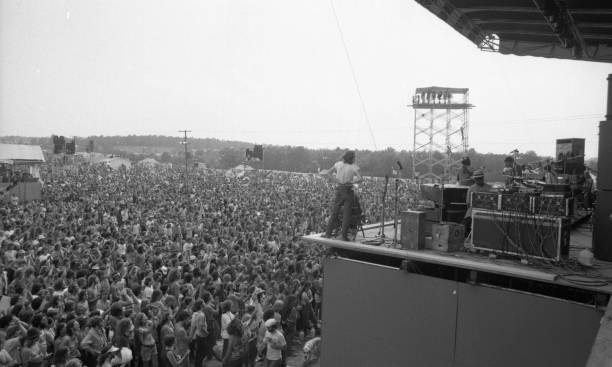
Bigger Than Woodstock: The Forgotten Rock Festival That Attracted 600,000 Fans
When people talk about the greatest rock festivals of all time, one name invariably comes up: Woodstock. Three days of peace, love, mud and music that became a defining moment of the 1960s.
But what if we told you Woodstock wasn't even the biggest rock festival of its era?
Four years later, on 28 July 1973, an estimated 600,000 music fans descended on Watkins Glen, New York, for an extraordinary concert featuring the Grateful Dead, The Allman Brothers Band and The Band.
That's around 200,000 more people than attended Woodstock in 1969.
Roads became enormous car parks. Thousands of fans abandoned their vehicles. Facilities struggled under the strain, and organisers faced the prospect of hundreds of thousands of people trying to enter a venue never intended to accommodate such a crowd.
Yet despite becoming one of the largest rock gatherings in history, Watkins Glen's Summer Jam has never enjoyed anything like Woodstock's legendary status.
So what happened at the festival that was bigger than Woodstock?
Three legendary bands, one enormous concert
The idea behind the Summer Jam at Watkins Glen was relatively straightforward.
Concert promoters Jim Koplik and Shelly Finkel wanted to bring together three of America's most exciting live bands for a spectacular day of music at the Watkins Glen Grand Prix Raceway in upstate New York.
And what a line-up they assembled.
First were the Grateful Dead, led by Jerry Garcia. By 1973, the band had built a devoted following thanks to their sprawling live performances, psychedelic improvisation and ability to turn almost any concert into a completely unpredictable musical journey.
Then there were The Allman Brothers Band, whose combination of blues, jazz and Southern rock had made them one of America's most formidable live acts. With Gregg Allman's unmistakable vocals and Dickey Betts' guitar playing, they were perfectly suited to a marathon outdoor performance.
Completing the bill was The Band, the Canadian-American group responsible for classics including The Weight and The Night They Drove Old Dixie Down.
Three legendary groups. One stage. Tickets priced at just $10.
What could possibly go wrong?
As it turned out, quite a lot.
The festival that attracted four times as many people as tickets sold
Promoters initially discussed a much smaller gathering, but demand quickly exceeded expectations.
Around 150,000 tickets were sold, already making Watkins Glen an enormous undertaking.
Then the crowds kept coming.
Word spread across America that something special was happening. Fans packed their cars, loaded up camping equipment and headed towards the Grand Prix Raceway.
By the time the festival arrived, an estimated 600,000 people had made the journey.
To put that into perspective, the crowd was larger than the population of many major American cities at the time.
And unlike modern festivals, where tightly controlled entry systems and sophisticated logistics help manage enormous crowds, Watkins Glen was operating with the infrastructure of a motor racing circuit in 1973.
The surrounding roads simply couldn't cope.
Traffic reportedly backed up for as much as 100 miles, with vehicles stretching along highways and country roads. Some people spent hours barely moving before deciding they'd have a better chance of reaching the festival on foot.
Thousands abandoned their cars and started walking.
Others arrived days early, pitching tents wherever they could find space.
The roads into Watkins Glen had effectively become part of the festival itself.
The extraordinary decision to make the concert free
With crowds swelling far beyond the number of tickets sold, organisers faced a serious problem.
There was no realistic way to process everyone through the gates without creating potentially dangerous bottlenecks.
Veteran concert promoter Bill Graham helped convince the organisers that public safety mattered more than collecting additional ticket revenue.
The solution was extraordinary.
Open the gates and let the remaining crowds enter for free.
It meant hundreds of thousands of people were admitted without paying the $10 ticket price.
By then, there was little alternative. Trying to turn such an enormous gathering away could have created an even more dangerous situation.
It was a remarkable decision, although one that also demonstrated just how completely the concert had outgrown its original plans.
And inside the venue, the problems were mounting.
Toilets, water shortages and a logistical nightmare
Providing basic facilities for 150,000 festivalgoers would have been difficult enough.
Accommodating around 600,000 was another matter entirely.
Organisers had arranged approximately 1,000 portable toilets, along with additional wells to increase the site's water supply.
Even so, the sheer number of people overwhelmed the available facilities.
Some attendees reportedly waited hours to use a toilet. Water was distributed free, but keeping such a vast audience supplied was a constant challenge.
For those near the front, Watkins Glen offered the chance to witness three incredible bands in one unforgettable setting.
Further back, the experience could be rather different.
Fans found themselves so far from the stage that seeing the performers was virtually impossible. Others struggled to hear the music clearly.
There was also the uncomfortable reality of hundreds of thousands of people spending an entire summer's day exposed to the elements.
And tragically, the event wasn't without loss of life.
A skydiver taking part in an aerial display died after flares attached to his equipment exploded during his descent.
It was a grim reminder of the dangers surrounding an event of such extraordinary scale.
Yet the overwhelming crowds, discomfort and logistical chaos didn't stop the music.
The Grateful Dead, Allman Brothers and The Band take the stage
For all the problems surrounding Watkins Glen, the musical performances were the reason everyone had made the journey.
The Grateful Dead opened the main concert with the kind of extended improvisational set that had made them one of America's great touring bands.
The atmosphere must have been extraordinary for those close enough to experience it properly.
Jerry Garcia and his bandmates were playing to a crowd vastly larger than most musicians would ever encounter.
The Band followed, bringing their distinctive mixture of Americana, folk, country and rock to the enormous audience.
Their set was interrupted by heavy rain, but the group eventually returned to complete its performance.
Then came The Allman Brothers Band.
Their Southern rock sound, built around intricate guitar work and lengthy instrumental passages, provided a fitting soundtrack as the evening stretched into the night.
And this wasn't simply three bands performing separate concerts.
As the event progressed, members of the groups joined forces for an extended late-night jam session, giving Watkins Glen the sort of musical collaboration that had inspired its creation in the first place.
The concert finally wound down in the early hours of Sunday morning.
Hundreds of thousands of exhausted fans were left with memories of an event unlike anything they had experienced before.
Of course, there was still one enormous problem.
They all had to get home.
The aftermath: abandoned cars, mountains of rubbish and angry residents
Once the music stopped, Watkins Glen had to deal with the consequences of hosting one of the largest rock crowds ever assembled.
Roads remained congested, and abandoned vehicles created additional difficulties.
The surrounding countryside was littered with rubbish, while local residents faced the disruption caused by hundreds of thousands of unexpected visitors.
Businesses experienced extraordinary demand, with supplies rapidly disappearing from shops across the area.
For those who had travelled to hear their favourite bands, it was an adventure.
For some of the people who actually lived in Watkins Glen, it was considerably less enjoyable.
Local authorities responded by introducing temporary restrictions on large gatherings, while residents later pursued legal action over property damage and disruption.
The event had demonstrated both the extraordinary pulling power of rock music and the risks of staging a concert on a scale that organisers could barely control.
But despite the difficulties, Watkins Glen became part of rock history.
Was Watkins Glen really bigger than Woodstock?
In terms of estimated attendance, absolutely.
The original Woodstock festival in August 1969 attracted approximately 400,000 people.
Watkins Glen's Summer Jam, held almost four years later, drew an estimated 600,000.
That's around 50% more people.
For years, Watkins Glen was recognised by Guinness World Records for attracting the largest audience at a pop festival.
But attendance figures only tell part of the story.
Woodstock had something that Watkins Glen lacked: a lasting cultural identity.
Its connection to the counterculture, anti-war movement and changing attitudes of the late 1960s made it much more than a music event.
The documentary film and hugely successful soundtrack also helped preserve its performances for generations of fans.
Watkins Glen, meanwhile, arrived in a different America.
By 1973, the idealism associated with the late 1960s had begun to fade. Rock music was becoming an increasingly powerful commercial industry, and enormous outdoor concerts were no longer quite the cultural shock they had been just a few years earlier.
There was no equivalent Woodstock-style feature film at the time to immortalise Summer Jam for a mass audience.
Instead, Watkins Glen gradually slipped into the background of rock history.
The forgotten giant of 1970s rock
More than half a century later, the Summer Jam at Watkins Glen remains a remarkable moment in music history.
Six hundred thousand people.
Three of America's greatest rock bands.
One enormous concert that overwhelmed the surrounding roads, stretched facilities to their limits and demonstrated just how far the popularity of live rock music had grown.
For many fans, it was undoubtedly an unforgettable experience.
For others, particularly those who spent hours walking to the venue only to find themselves unable to see or hear the performers properly, it was probably a rather expensive camping trip.
Yet the scale of the occasion was undeniable.
Woodstock will always have its place in rock mythology. But Watkins Glen deserves to be remembered alongside it.
After all, how many concerts can claim to have attracted more than half a million people to a single venue?
Watkins Glen wasn't Woodstock. It was bigger.
And that's a remarkable achievement for a festival so many rock fans have never even heard of.
Were you at Watkins Glen in 1973, or do you know someone who was? We'd love to hear your memories of this extraordinary concert.
For more fascinating stories about legendary bands, rock music controversies and forgotten moments in music history, explore the latest articles at Rocktee.