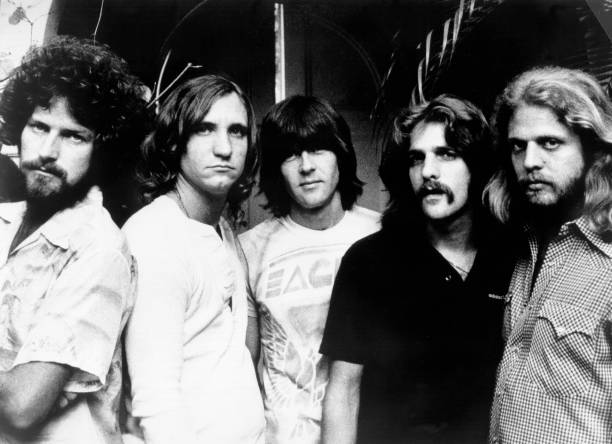
On 31 July 1980, the Eagles walked onstage at Long Beach Arena in California as one of the biggest rock bands in the world. By the end of the concert, two members had threatened to beat each other up, a guitar had been smashed and the band was effectively finished.
The Eagles had spent the best part of a decade perfecting their smooth Californian rock sound. With songs such as Hotel California, Take It Easy and Lyin' Eyes, they'd become international superstars, selling millions of records and filling arenas across America.
Behind those immaculate vocal harmonies, however, relations between the musicians were considerably less harmonious.
Years of relentless touring, disagreements over money, creative differences and increasingly strained friendships had taken their toll. By the summer of 1980, the Eagles were barely holding themselves together. And all it took to push them over the edge was a sarcastic remark made backstage.
The concert would become infamous in rock history as the Long Night at Wrong Beach.
Why were the Eagles fighting?
The problems within the Eagles hadn't appeared overnight. Formed in Los Angeles in 1971, the band had experienced extraordinary success throughout the decade. Their 1976 album Hotel California cemented their status as one of America's biggest musical exports. But success came at a price.
The recording of their follow-up album, The Long Run, had been particularly difficult. Released in 1979, it took considerably longer to complete than their earlier records, with mounting pressure to deliver something capable of matching Hotel California.
Glenn Frey and Don Henley had become the band's dominant creative partnership, while guitarist Don Felder was increasingly frustrated by the group's internal hierarchy. Felder had joined the Eagles in 1974 and played a significant part in developing their harder rock sound. Most notably, he originated the instrumental idea that became Hotel California.
Yet despite his musical contributions, Felder felt that important decisions were being made by Frey and Henley. By the time the band embarked on the final stretch of their Long Run tour, tensions were running dangerously high.
The backstage comment that started everything
The Eagles' performance on 31 July 1980 wasn't an ordinary concert. Held at Long Beach Arena, it was a fundraising event for California senator Alan Cranston, who was campaigning for re-election.
Glenn Frey had helped arrange the appearance, but Don Felder wasn't enthusiastic about involving the band in a political campaign. Before the performance, Cranston and his wife, Norma, met the musicians backstage to thank them for taking part. According to Felder's autobiography, Heaven and Hell: My Life in the Eagles, he politely greeted Norma before adding a sarcastic comment under his breath.
"I guess."
Unfortunately for Felder, Glenn Frey heard it. Frey interpreted the remark as disrespectful, particularly given his involvement in organising the event. The confrontation escalated backstage, with Frey later recalling that he became so angry he threw a beer bottle against a wall.
Rather than settling their differences before going onstage, the two musicians carried their anger into the performance. That was when an already uncomfortable situation became extraordinary.
The Eagles were threatening each other during the concert
For thousands of fans inside Long Beach Arena, the Eagles appeared to be delivering another polished performance. Behind the music, however, Glenn Frey and Don Felder were exchanging increasingly hostile remarks.
Felder later claimed that Frey approached him during the concert and threatened to fight him as soon as they left the stage.
As the evening continued, the two musicians reportedly began counting down the remaining songs, each anticipating a physical confrontation once the performance was over. At one point, Frey recalled the pair exchanging threats with just three songs left to play. The situation became so volatile that, according to Felder, sound engineers lowered Frey's microphone between songs to prevent the audience from hearing the arguments.
It's a remarkable image: one of the most commercially successful rock bands of the 1970s performing perfectly arranged songs while two of its members quietly prepared to attack each other.
The audience was hearing the Eagles. The musicians were experiencing something closer to a family argument that had finally gone too far.
The smashed guitar that marked the end
By the final encore, there was little chance of reconciliation. The two guitarists had spent much of the performance provoking one another, and the prospect of a backstage fight appeared increasingly likely.
But the confrontation never became the physical brawl they'd threatened. Instead, Felder left the stage and smashed an acoustic guitar against a concrete pillar.
Frey later recalled that Felder destroyed one of his cheaper instruments before making a swift departure. It was an explosive end to an evening that had begun with a simple backstage greeting. More importantly, it marked the breaking point of a band that had been struggling to function for years.
The Eagles had completed their final concert together for what would turn out to be nearly 14 years.
Did the Long Beach concert really break up the Eagles?
Although the performance became synonymous with the Eagles' break-up, the band's problems ran much deeper than one argument.
By 1980, the musicians were exhausted. The creative process had become increasingly difficult, the personal relationships were deteriorating and the constant pressure of maintaining their success had become overwhelming. Frey later acknowledged that he had already grown tired of the band.
The Long Beach confrontation was therefore less the cause of the Eagles' collapse than the incident that made their problems impossible to ignore.
Following the concert, the musicians went their separate ways. The band never issued the sort of dramatic farewell announcement that might be expected from a group of its stature. Instead, its activities effectively came to a halt.
Their live album, Eagles Live, appeared in November 1980, drawing on performances recorded during different periods of the band's career. Ironically, one of the recordings came from the disastrous Long Beach concert itself. Anyone listening to Life in the Fast Lane from that performance would be unlikely to suspect the hostility taking place between the musicians.
The Eagles reunion: When Hell Freezes Over
For years, the prospect of an Eagles reunion seemed remote. Don Henley famously suggested that the group would get back together when hell froze over. It was a suitably dismissive response to the reunion rumours that continued throughout the 1980s.
But in 1994, the seemingly impossible happened.
Glenn Frey, Don Henley, Don Felder, Joe Walsh and Timothy B. Schmit reunited for an MTV special and accompanying tour. The resulting live album was appropriately titled Hell Freezes Over. Fourteen years after the chaos at Long Beach, the Eagles were once again performing together. The reunion was enormously successful, demonstrating that the appetite for the band's music hadn't diminished during its absence.
Unfortunately, the old tensions hadn't entirely disappeared either.
What happened between Glenn Frey and Don Felder afterwards?
Although Don Felder returned for the 1994 reunion, his relationship with the band's leadership remained difficult. Disagreements over money and business arrangements eventually resulted in Felder being dismissed from the Eagles in 2001. That decision triggered further legal disputes, with Felder challenging aspects of his departure and the band's financial arrangements.
The parties eventually reached a settlement. Felder continued performing and recording as a solo artist, while the Eagles carried on without him. When Glenn Frey died in January 2016, the two musicians had never fully reconciled.
Felder subsequently expressed regret that they'd been unable to sit down together, put their differences aside and revisit their shared history. It was a sad conclusion to a relationship that had helped produce some of the most recognisable music of the 1970s.
One of rock music's most infamous final concerts
Rock history is filled with bands brought down by conflicting personalities, creative disagreements and disputes over money. But few break-ups have such a memorable final chapter. The Eagles didn't simply cancel a tour or announce their separation through a press statement. They completed an arena concert while two members exchanged threats, one of them destroyed a guitar and the group then went its separate ways.
What makes the Long Night at Wrong Beach particularly fascinating is the contrast between the music and the circumstances in which it was performed.
The Eagles built their reputation on precision, musicianship and seemingly effortless vocal harmonies. Yet on 31 July 1980, the men responsible for creating that sound could barely tolerate being in the same room. The concert didn't single-handedly destroy the Eagles. Years of resentment had already done much of the damage. But it provided one final, spectacular argument.
And for the next 14 years, that was where the story ended.
Love classic rock? Explore Rocktee's collection of rock band T-shirts and merchandise, featuring legendary artists and iconic albums from across rock music history.