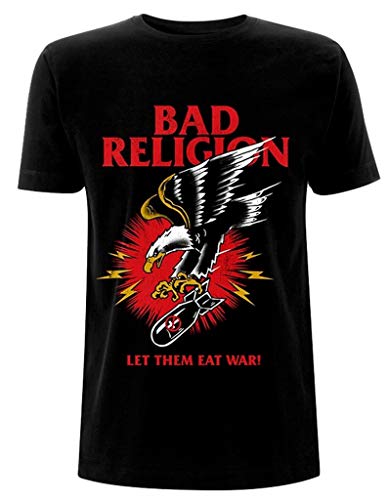

Bad Religion
Bad Religion T-Shirts Bad Religion, a seminal punk rock band formed in Los Angeles, California, in 1980, has been a defining force in the punk rock genre for over four decades.
Shop the band
Bad Religion merch
Bad Religion: melody with an argument
Bad Religion make punk rock that moves quickly without asking listeners to stop thinking. Formed in Los Angeles in 1980, the band developed a sound built on fast rhythms, tightly organised guitars and melodies strong enough to carry difficult questions. Their songs examine authority, belief, conformity and human behaviour, often placing an unsettling idea inside an immediately memorable chorus.
Singer Greg Graffin’s clear, controlled delivery is central to that balance. Rather than relying entirely on abrasion, he gives the words room to register. Layered backing vocals add another defining element: harmonies that broaden the songs without softening their attack. The result is recognisably hardcore-rooted, but unusually attentive to phrasing and melodic shape.
The records that define the sound
Suffer (1988) is the clearest starting point. Its short, concentrated songs bring speed, tunefulness and social criticism into sharp alignment. There is little wasted motion: riffs establish the pressure, the vocals articulate the argument, and the next song arrives before that pressure has fully lifted.
No Control (1989) pushes the economy further. It is a particularly useful listen for understanding how Bad Religion create variety within a disciplined framework. Changes in vocal emphasis, guitar movement and rhythmic weight matter as much as obvious shifts in tempo.
Against the Grain (1990) gives that approach more melodic reach. It includes “21st Century (Digital Boy)”, a song the band later revisited on Stranger Than Fiction (1994). Heard together, those records show how their songwriting could become more accessible without abandoning its sceptical outlook. Stranger Than Fiction offers a fuller introduction for listeners coming from alternative rock rather than hardcore.
For a later entry point, The Process of Belief (2002) reconnects forceful playing with the band’s established melodic precision. It demonstrates that the appeal is not simply speed: the strongest passages depend on tension between the rush of the instruments and the careful construction of the vocals.
A visual identity built around a question
Bad Religion’s best-known symbol is the crossbuster: a Christian cross inside a prohibition sign. Its blunt geometry works differently from the songs’ dense language, communicating confrontation at a glance. In the context of the band’s writing, it connects to a broader resistance to unquestioned authority and dogma.
Their record artwork also provides a visual vocabulary beyond the logo. Suffer’s burning figure in a suburban setting turns an ordinary environment into something deeply uneasy. That contrast suits a band whose songs repeatedly question ideas and systems that can otherwise pass as normal.
What that means for merch
For anyone drawn to Bad Religion merchandise, the useful distinction is between the central symbol and artwork tied to a particular record. Crossbuster-led imagery foregrounds the band’s most direct visual statement; album-based imagery can express a more specific attachment to the music.
Neither needs an elaborate explanation, but both carry meaning. The strongest connection is personal: a record that changed how you listened, a lyric that prompted an argument, or a visual identity that reflects the music’s refusal to accept easy answers.