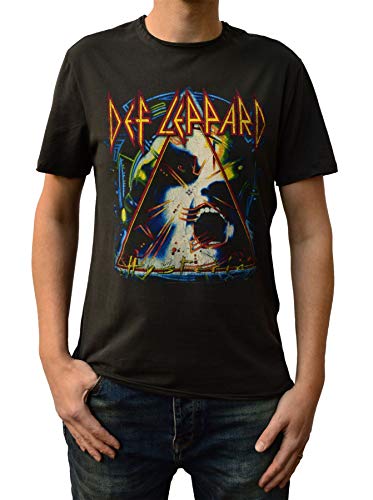

Def Leppard
Def Leppard t-shirts and merchandise, hand-picked by RockTee.
Shop the band
Def Leppard merch
Def Leppard: precision with a rock ’n’ roll pulse
Def Leppard’s sound sits between hard rock muscle and pop songwriting discipline. Formed in Sheffield in 1977, the band emerged alongside the New Wave of British Heavy Metal, but their ambitions soon stretched beyond that scene’s boundaries. They kept the guitars prominent while making room for layered vocals, carefully shaped arrangements and choruses designed to stick.
That balance is central to their appeal. A Def Leppard song can feel immediate on first hearing, yet reveal a dense construction underneath: interlocking guitar parts, vocal harmonies and percussion that gives each hook space to land. Joe Elliott’s rasp provides a rough edge against the polished production.
The records that shaped the sound
The debut album, On Through the Night (1980), captures a leaner, more restless band. Its direct riffs and youthful energy make a useful starting point for listeners curious about the foundations beneath the later studio gloss.
High ’n’ Dry (1981) tightened that approach with producer Robert John “Mutt” Lange. “Let It Go” delivers a tougher guitar attack, while “Bringin’ On the Heartbreak” shows how naturally the band could move between restraint and release. It is an important bridge between their early hard rock identity and their more expansive work.
With Pyromania (1983), those elements became a distinctive formula. “Photograph”, “Rock of Ages” and “Foolin’” combine forceful riffs with melodic clarity. The production is meticulous, but the songs retain enough bite to avoid feeling overly tidy.
Hysteria (1987) takes that studio-minded approach further. Guitars become both rhythmic engines and finely placed textures; backing vocals often act like another instrument. “Animal”, “Love Bites”, “Pour Some Sugar on Me” and the title track demonstrate how widely the band could vary the mood without losing its identity. For understanding Def Leppard’s combination of rock weight and pop architecture, this is the central record.
Adrenalize (1992) continues the bright, harmony-rich sound, while Slang (1996) offers a useful contrast through darker colours and less familiar textures. Together, they show both the durability of the band’s established style and its willingness to step outside it.
A visual identity built for recognition
Def Leppard’s angular logo is as immediately recognisable as their stacked vocal harmonies. Its sharp geometry suggests motion and volume, giving the name a graphic presence that works independently of a band photograph.
The record artwork adds another layer. Pyromania uses an unsettling urban image, while Hysteria favours a surreal, illustrated face and fractured composition. These are distinct visual worlds rather than interchangeable rock imagery, helping each album maintain its own identity.
For readers interested in merchandise, that distinction is worth considering. A logo-led design expresses an attachment to the band as a whole; album artwork points towards a particular sound, period or personal connection. Def Leppard’s visual language offers both routes without needing much explanation.
Where to begin
Start with Pyromania for the balance of bite and melody, then move to Hysteria for the fullest expression of their layered production. Follow with High ’n’ Dry to hear the harder-edged roots.