

Green Day
Green Day t-shirts and merchandise, hand-picked by RockTee.
Shop the band
Green Day merch
Green Day: Melody with an Abrasive Edge
Green Day’s sound rests on a productive tension: sharp, economical punk rock delivered with an instinct for pop songwriting. Billie Joe Armstrong’s voice can move from a sneer to something disarmingly vulnerable, while bassist Mike Dirnt and drummer Tré Cool give the songs movement beyond a simple guitar charge. The hooks arrive quickly, but anxiety, boredom and frustration often sit underneath them.
Emerging from California’s East Bay punk scene, the band brought that sensibility to a much wider audience without settling into one fixed approach. Their catalogue stretches from scrappy early recordings to acoustic reflection and politically charged rock opera. What connects those phases is a knack for making complicated feelings sound immediate.
The Records That Define the Sound
Kerplunk captures Green Day before their major-label breakthrough: rough around the edges, tuneful and already confident in its shifts between defiance and insecurity. It is a useful starting point for listeners who want to hear the foundations rather than begin with the biggest singles.
Dookie sharpened those strengths into a remarkably focused record. “Basket Case”, “Longview” and “When I Come Around” show different sides of the same band: nervous momentum, bass-led restlessness and a more measured melodic pull. Dirnt’s bass parts are central to its character, frequently acting as hooks rather than simply following the guitar.
Insomniac pushed towards a harsher, more compressed attack. For anyone drawn to Green Day’s bite rather than their softer side, it is an important companion to Dookie. Nimrod, meanwhile, widened the palette. Its stylistic variety includes the acoustic “Good Riddance (Time of Your Life)”, a reminder that Armstrong’s songwriting does not depend on distortion.
Warning took that openness further, leaning into acoustic textures and a looser, more reflective feel. Then American Idiot expanded the band’s scale through connected characters, political anger and multi-part songs such as “Jesus of Suburbia”. Its ambition worked because the individual melodies remained strong. 21st Century Breakdown continued that theatrical, concept-driven approach.
Visual Identity: From Cartoon Chaos to Bold Symbols
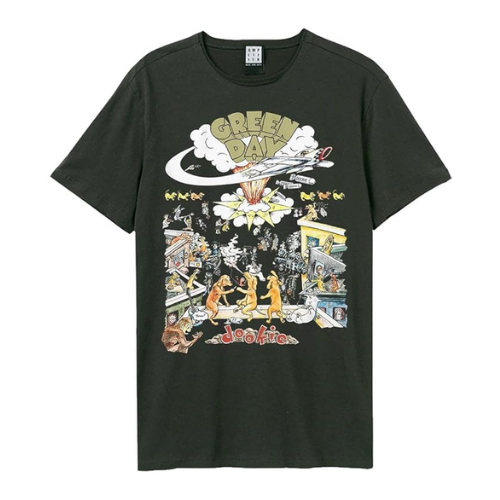
Green Day’s artwork offers distinct ways into the band’s identity. Dookie uses dense cartoon imagery: busy, irreverent and full of details that reward a closer look. Its visual clutter suits music rooted in everyday irritation and unruly humour.
Nimrod takes a different route, placing conspicuous yellow circles over faces in its cover photograph. The intervention is simple but disruptive, turning an otherwise formal image into something cheekier and less stable.
American Idiot is more immediately symbolic. Its heart-shaped grenade, held in a hand, brings affection and violence into one image. The red, white and black palette gives that era a graphic clarity quite different from Dookie’s crowded artwork.
How That Carries into Merch
For Green Day merch, the artwork is often as meaningful as the band name. Choosing an album-led design can signal which part of their catalogue matters most to you: early irreverence, restless experimentation or the broader political theatre of American Idiot.
It is worth looking beyond the logo and considering the image itself. Green Day’s strongest visual identities do more than identify the band; they reflect the mood of the records behind them.