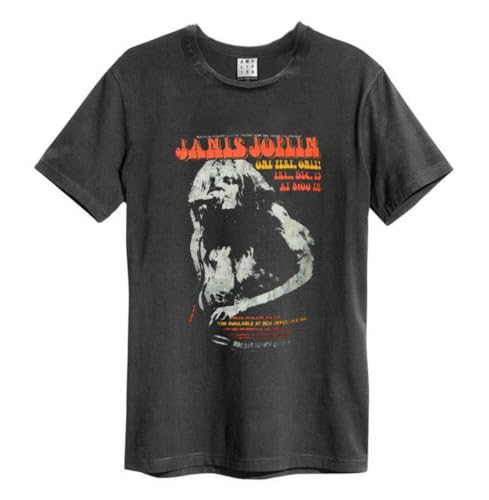
Janis Joplin
Amplified Janis Joplin Madison Square Gardens Mens Band T-Shirt
Check price at AmazonBuy now

Janis Joplin t-shirts and merchandise, hand-picked by RockTee.
Shop the band
Janis Joplin’s music sits where blues, soul and psychedelic rock meet, but genre labels only explain so much. The real centre is her voice: rough-edged, rhythmically alert and capable of moving from a near-whisper to a full-throated cry within a phrase. She could make a song sound confrontational and vulnerable at once.
Her recordings are worth hearing beyond the biggest choruses. Listen to how she stretches a syllable, hangs behind the beat or lets a quieter line expose the feeling underneath. The force matters because it has contrast. Joplin wasn’t simply singing loudly; she was shaping performances around tension, release and the emotional weight of individual words.
Joplin first reached a wide audience as the singer with San Francisco’s Big Brother and the Holding Company. Their sound placed her blues instincts inside a loose, guitar-heavy psychedelic setting, with a friction between voice and band that remains central to its appeal.
Cheap Thrills (1968) is the essential record from that partnership. ‘Piece of My Heart’ turns a plea for affection into something bruised and defiant, while ‘Ball and Chain’ gives Joplin room to build an extended emotional argument. ‘Summertime’ takes a familiar standard somewhere darker, framed by winding electric guitars.
The album’s appeal isn’t studio neatness. It is the sense of musicians pushing against one another, with Joplin’s voice cutting through the noise without losing its human grain.
I Got Dem Ol’ Kozmic Blues Again Mama! (1969) shifted towards a horn-driven blend of rock, blues and soul. Compared with Big Brother’s tangled guitar sound, these arrangements gave Joplin a different framework: brass accents, deeper grooves and more room for the influence of rhythm and blues. ‘Try (Just a Little Bit Harder)’ is a useful entry point.
Pearl, released posthumously in 1971, offers another perspective. Backed by the Full Tilt Boogie Band, Joplin sounds at home in arrangements that are more focused without becoming restrained. ‘Move Over’ has a sharp rock pulse; ‘Cry Baby’ lets her work through dramatic changes in intensity.
‘Me and Bobby McGee’ shows her gift for storytelling, building from conversational warmth towards release. The unaccompanied ‘Mercedes Benz’ reveals something equally important: humour, timing and personality, without a band to carry the performance.
Joplin’s visual identity is inseparable from her music, but it is more individual than a generic version of 1960s psychedelia. Round glasses, layered jewellery, flowing clothes and an unguarded stage presence form a recognisable image without the uniformity of a carefully managed band look.
Two record sleeves offer distinct visual starting points: Robert Crumb’s densely illustrated artwork for Cheap Thrills and the seated photographic portrait on Pearl. One captures the busy countercultural world around the music; the other brings attention back to Joplin herself.
For anyone exploring Joplin merchandise, those differences are useful. Portrait-led artwork foregrounds the performer, while album imagery connects more directly to a particular sound and period. The strongest visual connection comes from choosing the record or image that means something to you.