

Joy Division
Joy Division t-shirts and merchandise, hand-picked by RockTee.
Shop the band
Joy Division merch

Joy Division
Amplified Black Joy Division Love Will Tear Us Apart T-Shirt
Check price on AmazonBuy now

Joy Division: Tension, Space and Lasting Influence
Joy Division made a small body of recorded work feel unusually expansive. Emerging from the Manchester punk scene in the late 1970s, Ian Curtis, Bernard Sumner, Peter Hook and Stephen Morris developed a sound that retained punk’s directness while moving towards something more spacious, rhythmically intricate and emotionally unsettled.
Their music is often described as bleak, but that tells only part of the story. There is physical momentum in these songs: basslines that pull forward, drums that refuse to settle and guitar parts that cut across the rhythm rather than simply reinforce it. Curtis’s low, urgent voice gives that movement its human centre.
A Sound Built Around Contrast
One of Joy Division’s defining features is the relationship between Hook’s bass and Sumner’s guitar. The bass frequently carries the memorable melodic phrase, while the guitar supplies abrasion, atmosphere or sudden flashes of brightness. Morris’s precise drumming connects them, giving even the most uneasy passages a firm rhythmic structure.
Producer Martin Hannett helped shape the recorded identity of the band, using space, separation and studio effects to make instruments sound both distinct and strangely distant. The result is not simply a document of four musicians playing in a room. It is a carefully constructed environment, with silence and decay doing almost as much work as the notes.
That balance between bodily energy and psychological distance remains central to Joy Division’s appeal.
The Key Records
Unknown Pleasures (1979) is the clearest starting point. “Disorder” opens with restless momentum, while “Day of the Lords” moves with greater weight. “She’s Lost Control” turns repetition into tension, and “New Dawn Fades” shows how gradually the band could build emotional force without overcrowding an arrangement.
Closer (1980) pushes further into stark textures and increasingly prominent keyboards. “Atrocity Exhibition” is driven by an insistent, unsettled rhythm; “Isolation” places Curtis’s vocal against a brisk electronic framework. By “The Eternal” and “Decades”, the album has reached a slower, more spacious register. It rewards listening as a complete sequence rather than treating it solely as a collection of individual songs.
The singles offer another route in. “Transmission” captures the band’s propulsion particularly well, while “Love Will Tear Us Apart” joins an immediately recognisable melody to a lyric of intimate disconnection. Neither needs to be treated as a substitute for the albums: each reveals a different balance within the same musical language.
Visual Identity and Merch
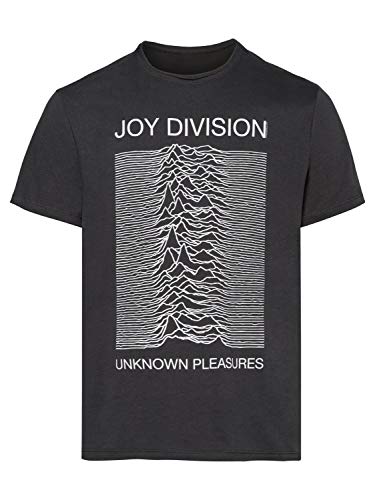
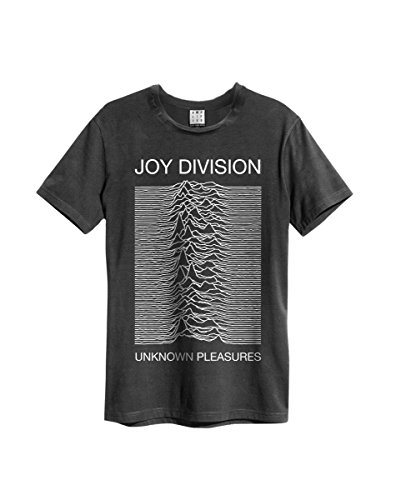
Joy Division’s visual identity is inseparable from the restrained design associated with Factory Records and Peter Saville. The stacked white waveforms on Unknown Pleasures give the music an abstract counterpart: ordered at first glance, unstable on closer inspection.
The funerary photograph used for Closer creates a different mood, bringing memory, mortality and historical distance into the artwork. Across both sleeves, the absence of conventional band portraiture leaves room for interpretation.
For merch, that distinction matters. These images are more than convenient logos; they belong to particular records and ways of listening. Choosing artwork connected to the album that means most to you offers a more personal starting point than recognisability alone.