
Judas Priest
Judas Priest t-shirts and merchandise, hand-picked by RockTee.
Shop the band
Judas Priest merch
Judas Priest: precision, power and heavy metal identity
Judas Priest helped give heavy metal both its musical vocabulary and its visual shape. Emerging from Birmingham, the band developed a sound built on twin guitars, commanding vocals and a balance between melody and force. Their catalogue stretches from shadowy, progressive early work to tightly structured anthems and high-speed metal, without losing its recognisable character.
That range matters. Priest are not simply a band who play louder or faster: their strongest records use contrast, placing clean melodic lines against hard-edged riffs and giving Rob Halford room to move from controlled menace to piercing high notes.
The sound: two guitars, plenty of space
The partnership of guitarists Glenn Tipton and K. K. Downing became central to Priest’s classic sound. Harmonised leads, alternating solos and sharply defined rhythm parts made the guitars feel like interacting voices rather than a single block of distortion.
Underneath that detail sits a direct rhythmic foundation. Some songs push forward with relentless momentum; others depend on a measured stomp or a spacious, ominous groove. Halford’s theatrical delivery connects those approaches, bringing drama without sacrificing the shape of the song.
Priest also helped sharpen metal’s separation from blues-based hard rock. The blues never disappears entirely, but their increasingly precise riffs and cutting guitar attack point towards the speed and intensity later metal bands would explore.
Key records: from atmosphere to attack
Sad Wings of Destiny (1976) is the essential early statement. “Victim of Changes” and “The Ripper” capture a band working with atmosphere, ambitious arrangements and sudden changes of intensity. It is heavy music with room for tension and restraint.
Stained Class (1978) tightens that approach. Its leaner attack and darker mood make it an important bridge between Priest’s exploratory beginnings and their more streamlined records.
British Steel (1980) distils the band into concise, durable songs. “Breaking the Law” and “Living After Midnight” show how effectively Priest could make metal accessible without removing its bite.
Screaming for Vengeance (1982) combines that directness with a brighter, more aggressive edge. The opening sequence of “The Hellion” and “Electric Eye” offers a particularly clear introduction to the band’s blend of melody, precision and theatrical scale.
Painkiller (1990) takes a different route: faster, more demanding and driven by Scott Travis’s drumming. For a later entry point, Firepower (2018) demonstrates how convincingly Priest could revisit their core strengths without merely repeating an earlier record.
Visual identity and merchandise
Priest’s leather-and-studs stage image became closely associated with heavy metal itself. Halford’s use of leather-club imagery helped bring a distinctive visual language into the band’s presentation: confrontational, disciplined and deliberately separate from everyday dress.
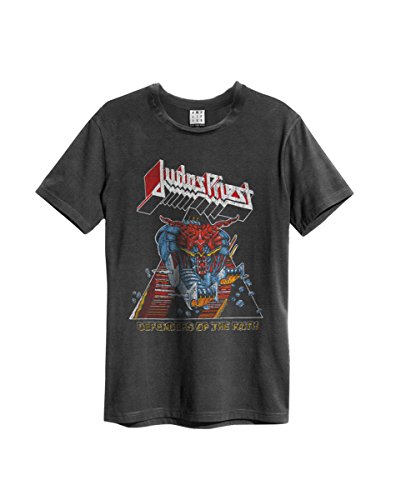
The artwork offers another route into that identity. The metallic bird of Screaming for Vengeance, the machine-like creature on Defenders of the Faith and the airborne figure of Painkiller translate the music into images of machinery, movement and menace.
For readers interested in band merchandise, those differences provide useful context. An album-led design can express a particular side of Priest: early darkness, concise anthem-writing or the intensified attack of Painkiller. The angular Judas Priest logo ties those eras together, remaining recognisable even as the surrounding imagery changes.