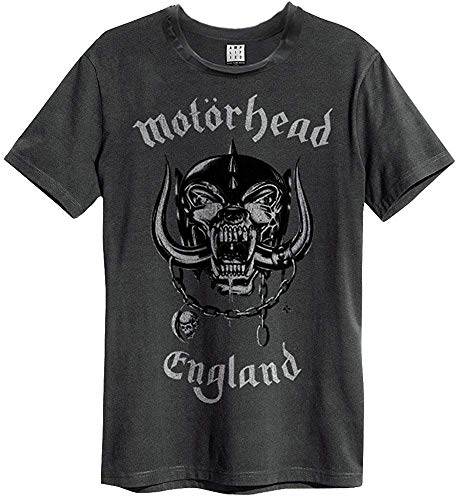

Motorhead
Motorhead t-shirts and merchandise, hand-picked by RockTee.
Shop the band
Motorhead merch
Motörhead: Rock ’n’ Roll Without the Soft Edges
Motörhead made the boundaries between hard rock, heavy metal and punk feel less important than the noise coming out of the speakers. Formed in London in 1975 by bassist and vocalist Lemmy Kilmister, the band built its identity around speed, distortion and a stubborn commitment to rock ’n’ roll.
Their appeal was never just about playing loudly. Beneath the abrasion were sharp hooks, blues-rooted riffs and a sense of swing that kept the music moving. Motörhead could sound confrontational without becoming ponderous: even their heaviest songs often felt like they were leaning forwards.
The Sound: Bass Up Front, No Wasted Motion
Lemmy’s bass was central to that approach. Overdriven and played with a pick, it occupied space usually reserved for rhythm guitar, giving the band a thick, grinding foundation. His rough-edged voice sat naturally within that sound rather than floating above it.
The trio of Lemmy, guitarist “Fast” Eddie Clarke and drummer Phil “Philthy Animal” Taylor established many of the band’s defining recordings. Clarke’s guitar brought bluesy bite and concise lead work, while Taylor’s drumming combined urgency with a loose, human push.
That balance matters. Motörhead helped shape the vocabulary of speed and thrash metal, but their own music retained the directness of early rock ’n’ roll. The riffs were forceful; the songs still had room for a grin.
Key Records: Where to Begin
Overkill (1979) is a strong introduction to the band’s physical impact. Its title track puts Taylor’s double-bass drumming at the centre of a relentless charge, while the album makes clear how much groove lived inside the racket.
Released later in 1979, Bomber offers another view of the same line-up: lean, dirty and built around memorable guitar figures. Together, these records capture a band refining its attack without polishing away its character.
Ace of Spades (1980) is the obvious starting point, and a useful one. The title track compresses Motörhead’s strengths into a short, tightly constructed burst. Beyond it, songs such as “Love Me Like a Reptile” and “The Chase Is Better Than the Catch” show that the album’s appeal extends well past its best-known riff.
For the live picture, turn to No Sleep ’til Hammersmith (1981). It captures the pressure and momentum of Motörhead onstage, where familiar songs become rougher and more insistent.
Visual Identity: Snaggletooth and the Wordmark
Motörhead’s artwork is as immediately recognisable as Lemmy’s voice. Artist Joe Petagno created the tusked, snarling figure commonly known as Snaggletooth, which became a recurring centrepiece of the band’s visual world.
Paired with the angular Motörhead wordmark, it gives merchandise a clear connection to the music: abrasive, darkly comic and unapologetically confrontational. Album artwork offers another route into that identity, from Bomber’s aircraft imagery to the desert-set cover of Ace of Spades.
For anyone choosing a Motörhead design, the useful distinction is between the broader band emblem and artwork tied to a particular record. One represents the whole musical identity; the other makes a more personal statement about the songs that brought you in.