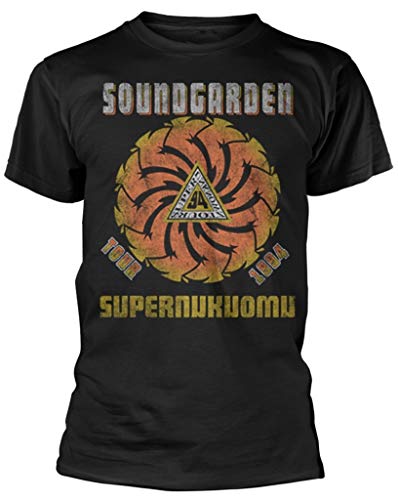

Soundgarden
Soundgarden t-shirts and merchandise, hand-picked by RockTee.
Shop the band
Soundgarden merch
Soundgarden: weight, space and a restless streak
Soundgarden made heavy music feel unstable in the best sense: riffs shifted beneath the beat, melodies stretched beyond familiar shapes, and quiet passages could be as unsettling as the loudest ones. Formed in Seattle in 1984, the band became central to grunge without fitting neatly inside it. Their sound drew on Black Sabbath’s weight, psychedelic rock’s strangeness and punk’s abrasive economy.
Chris Cornell’s voice was the most immediate feature, moving from a low, grainy register to piercing high notes. Just as important was the interplay around him: Kim Thayil’s angular guitar work, Matt Cameron’s intricate drumming and, from 1990, Ben Shepherd’s muscular, inventive bass playing. Soundgarden could sound enormous without smoothing away their awkward edges.
The sound: heavy riffs with unexpected turns
A Soundgarden riff rarely behaves quite as expected. Unusual metres and alternative tunings gave their songs a lurching, asymmetrical feel, but the writing remained physical rather than academic. “Outshined” lands with blunt force; “Spoonman” turns an off-centre rhythmic pattern into something immediately memorable.
Thayil’s guitar playing often adds friction rather than decoration. His leads can scrape and spiral, while Cornell’s melodies provide a strong emotional thread through the noise. That contrast matters: beneath the volume, these are frequently songs of unease, isolation and doubt.
There is humour and theatricality too, particularly in the earlier material. Soundgarden’s darkness was never simply a fixed pose.
Key records: where to begin
Ultramega OK (1988) and Louder Than Love (1989) capture the band’s early mixture of underground abrasion and expansive hard rock. They are useful starting points for hearing how much strangeness survived the move towards a broader audience.
Badmotorfinger (1991) brings the attack into sharper focus. “Rusty Cage”, “Outshined” and “Jesus Christ Pose” combine tightly controlled playing with a sense of volatility. For listeners drawn to Soundgarden’s heavier side, this is the clearest entry point.
Superunknown (1994) widens the picture. “Black Hole Sun” pairs a luminous melody with an uncanny atmosphere, while “Fell on Black Days” and “The Day I Tried to Live” show the band’s emotional and compositional range. Its accessibility never comes at the expense of tension.
Down on the Upside (1996) feels looser and more exploratory, with “Burden in My Hand” and “Pretty Noose” balancing strong hooks against unsettled textures. King Animal (2012), their reunion studio album, reconnects with the band’s distinctive rhythmic and tonal language without merely repeating an earlier record.
Visual identity and merch
Soundgarden’s visual identity makes room for both directness and disorientation. Bold lettering sits alongside imagery that feels distorted, psychedelic or difficult to decode at first glance. The artwork associated with Badmotorfinger and Superunknown offers two distinct routes into that world: graphic intensity on one side, blurred, dreamlike unease on the other.
For anyone choosing Soundgarden merch, the most meaningful starting point is often a record rather than a logo alone. Album-led artwork can express which part of the band resonates most: the dense attack, the psychedelic atmosphere or the tension between them.