
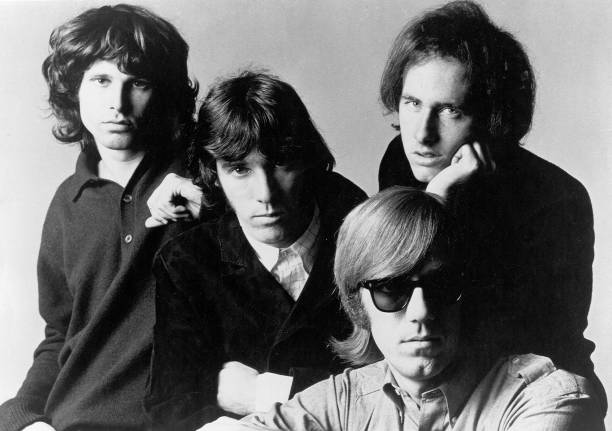
The Doors
Explore The Doors' music, iconic albums and psychedelic rock legacy. Discover The Doors T-shirts, hoodies, vinyl records and classic band merchandise.
Shop the band
The Doors merch


The Doors: Psychedelic Rock's Darkest Poets
Few bands captured the restless spirit of the late 1960s quite like The Doors. While their contemporaries embraced flower power and psychedelic experimentation, the Los Angeles quartet explored something more unsettling. Their music was seductive, unpredictable and frequently confrontational, mixing blues, jazz and rock with lyrics drawn from poetry, mythology and the darker corners of human behaviour.
Formed in 1965, The Doors brought together vocalist Jim Morrison, keyboardist Ray Manzarek, guitarist Robby Krieger and drummer John Densmore. Their unusual instrumental line-up, often performing without a conventional bass guitarist, helped establish a sound that was instantly recognisable.
Morrison's commanding baritone and provocative stage presence made him the band's most famous member, but The Doors were never simply a vehicle for their charismatic frontman. Manzarek's swirling organ, Krieger's expressive guitar work and Densmore's jazz-influenced drumming created the atmospheric foundation that allowed Morrison's lyrics to move between intimacy, menace and theatrical excess.
Their original recording career lasted just a few years with Morrison, yet the music they produced remains among the most distinctive of the classic rock era.
The Sound: Psychedelic Rock with a Dangerous Edge
Where many rock bands of the 1960s built their sound around distorted guitars, The Doors frequently placed Ray Manzarek's keyboards at the centre of their arrangements.
His Vox Continental organ gave early recordings their distinctive character, while his Fender Rhodes keyboard bass supplied the low-end foundation during live performances. In the studio, bass guitarists were often brought in to add depth to the recordings.
That unusual approach left plenty of space for Robby Krieger's guitar. Influenced by flamenco, blues and jazz, Krieger favoured fluid melodic phrases over conventional rock riffs. John Densmore's drumming was equally inventive, shifting between delicate rhythmic patterns and explosive improvisation.
The results could be hypnotic or unnerving, sometimes within the same song.
"Light My Fire" combines an instantly recognisable keyboard introduction with extended instrumental passages that reveal the band's jazz influences. "People Are Strange" wraps a sense of isolation in an almost playful melody, while "Break On Through (To the Other Side)" delivers its restless energy through a driving rhythm and Morrison's increasingly urgent vocals.
Then there's "The End", an eleven-minute journey through surreal imagery, unsettling poetry and gradually escalating musical tension.
The Doors were capable of writing concise, commercially successful singles, but their most ambitious work pushed well beyond the conventional boundaries of popular music.
Key Records to Start With
The Doors (1967) is the natural starting point. Their self-titled debut contains "Break On Through (To the Other Side)", "Light My Fire" and "The End", three recordings that demonstrate the remarkable range of a band still at the beginning of its career. Its blend of blues, psychedelia and theatrical songwriting remains compelling decades later.
Strange Days (1967) takes the band's darker tendencies further. Tracks including "People Are Strange", "Love Me Two Times" and "When the Music's Over" develop the atmospheric qualities of the debut, with increasingly adventurous arrangements and studio experimentation.
Waiting for the Sun (1968) brought The Doors their first number-one album in the United States. "Hello, I Love You" became a major hit, while songs such as "Spanish Caravan" and "Five to One" demonstrated their ability to move between delicate acoustic passages and confrontational rock.
Morrison Hotel (1970) marked a return to a more direct, blues-driven sound. Opening with the powerful "Roadhouse Blues", the album strips away some of the elaborate production of earlier releases in favour of muscular performances and a looser, more spontaneous atmosphere.
L.A. Woman (1971) was the final Doors studio album released during Jim Morrison's lifetime. Featuring "Riders on the Storm", "Love Her Madly" and the title track, it finds the band embracing blues and roots rock while retaining the atmospheric qualities that made their earlier recordings so distinctive. Morrison died in Paris just three months after its release.
For listeners exploring The Doors beyond their best-known singles, these albums reveal a group whose musical ambitions were every bit as important as their notorious reputation.
Jim Morrison and the Legacy of The Doors
The Doors' history is inseparable from Jim Morrison, whose unpredictable performances and fascination with poetry, philosophy and mortality made him one of rock music's most compelling figures.
Nicknamed the Lizard King, Morrison became a symbol of the late-1960s counterculture. His willingness to challenge audiences and conventional expectations attracted both devoted followers and considerable controversy.
His arrest following a performance in Miami in 1969, and the subsequent legal proceedings, overshadowed the band's later career. Increasing tensions surrounding live performances also contributed to their retreat from extensive touring.
In 1971, Morrison moved to Paris, where he died on 3 July at the age of 27.
Manzarek, Krieger and Densmore continued recording as The Doors, releasing Other Voices later that year and Full Circle in 1972. However, the absence of Morrison fundamentally changed the group's identity, and the surviving trio eventually moved on to other projects.
The music continued to attract new listeners, particularly following the renewed interest generated by Morrison's biography and the band's portrayal in popular culture.
What has endured is more substantial than the mythology surrounding their singer. The Doors produced a catalogue that still sounds unusual, adventurous and remarkably difficult to categorise.
Visual Identity and Merch
The Doors' visual identity remains one of the most recognisable in classic rock, combining bold typography, psychedelic artwork and striking photographs of Jim Morrison and his bandmates.
Their famous band logo, with its distinctive geometric lettering, has appeared on countless record sleeves, posters and T-shirts. Its clean, instantly recognisable design provides an interesting contrast to the unpredictable music associated with the name.
Album artwork offers another route into The Doors' visual history.
The debut album's stark band photography captures their early Los Angeles identity, while the colourful imagery of Strange Days reflects the more theatrical side of their psychedelic sound. The Morrison Hotel cover, featuring the group photographed through a hotel window, remains one of rock's most memorable sleeve designs.
For fans choosing The Doors merchandise, there are several approaches worth considering.
A classic black Doors T-shirt featuring the band's logo offers a simple connection to their music, while designs incorporating Jim Morrison portraits or vintage concert imagery capture the atmosphere of their late-1960s performances.
Album artwork T-shirts provide a more specific reference, particularly designs inspired by L.A. Woman, Strange Days and their self-titled debut.
Vinyl collectors also have plenty to explore, from reissues of the original studio albums to live recordings that reveal the band's improvisational abilities.
Whether it's a vintage-style band tee, a hoodie featuring the iconic Doors logo or a carefully chosen vinyl pressing, the best merchandise reflects an aspect of the group's music and history that genuinely resonates with the listener.
More than half a century after their most celebrated recordings, The Doors continue to occupy a distinctive place in rock history.
Their combination of poetic ambition, musical experimentation and unsettling atmosphere has proved difficult to imitate. For a band whose original era was so brief, their influence has been extraordinarily long-lasting.